
Resources
Helpful Resources for Central Valley Families
Building a strong support network is essential. We have compiled a list of trusted local organizations and regional centers to help guide you on your journey.
Sacramento Regional Resources
%201.avif)
Alta California Regional Center (ACRC)
Alta California Regional Center (ACRC) provides support and service coordination for individuals with developmental disabilities and their families across the Sacramento region (Sacramento, Yolo, Sutter, Colusa, Yuba, Nevada, Sierra, Placer, El Dorado, and Alpine counties), including autism services, early intervention, independent living support, and family resources.

Sacramento Autistic Spectrum and Special Needs Alliance
Sacramento Autistic Spectrum and Special Needs Alliance provides family support, social programs, advocacy, inclusive activities, and community connections for autistic individuals and families.

Resources for Independent Living
Resources for Independent Living offers independent living support, advocacy, housing resources, assistive technology help, and transition services for people with disabilities.

Special Olympics Northern California
Special Olympics Northern California provides inclusive sports, recreation, and social opportunities for children and adults with intellectual disabilities.

NAMI Sacramento
NAMI Sacramento offer mental health education, peer support groups, and family support programs for individuals living with mental health conditions and developmental disabilities.

WarmLine Family Resource Center
WarmLine Family Resource Center is a parent-led nonprofit that helps families navigate IEPs, Alta Regional services, Early Start, therapies, and special education support.

UC Davis MIND Institute
UC Davis MIND Institute offers autism and neurodevelopmental evaluations, parent education, support groups, research programs, and family navigation services.
San Joaquin Regional Resources
.avif)
Valley Mountain Regional Center (VMRC)
Valley Mountain Regional Center (VMRC) provides support and service coordination for individuals with developmental disabilities and their families across the San Joaquin valley (Amador, Calaveras, San Joaquin, Stanislaus, and Tuolumne counties), including autism services, early intervention, independent living support, and family resources.

The Arc San Joaquin
The Arc San Joaquin provides advocacy, family support, programs for individuals with intellectual and developmental disabilities, and community inclusion services.
.avif)
Family Resource Network (FRN)
Family Resource Network (FRN) supports families raising children and young adults, birth to age 22, with disabilities, developmental delays, medical needs, or learning differences throughout Amador, Calaveras, San Joaquin, Stanislaus, and Tuolumne Counties. FRN provides parent support, information and referrals, advocacy, workshops, and educational resources to help families navigate services, special education, and community supports while empowering caregivers through connection and shared experience.
.avif)
Disability Resources Agency for Independent Living (DRAIL)
Disability Resources Agency for Independent Living (DRAIL) provides independent living support organization offering advocacy, assistive technology resources, peer support, housing help, and transition services.

211 San Joaquin
211 San Joaquin — Free countywide referral service that connects families to disability supports, housing, food assistance, healthcare, transportation, respite care, and mental health services.

Main Street Youth and Family Services
Main Street Youth and Family Services is a Family support organization offering foster/adoption services, behavioral health support, parenting classes, and developmental disability resources.
Special Olympics Northern California
Special Olympics Northern California provides inclusive sports, recreation, and social opportunities for children and adults with intellectual disabilities.
Stanislaus Regional Resources
Valley Mountain Regional Center (VMRC)
Valley Mountain Regional Center (VMRC) provides support and service coordination for individuals with developmental disabilities and their families across the San Joaquin valley (Amador, Calaveras, San Joaquin, Stanislaus, and Tuolumne counties), including autism services, early intervention, independent living support, and family resources.
Family Resource Network (FRN)
Family Resource Network (FRN) supports families raising children and young adults, birth to age 22, with disabilities, developmental delays, medical needs, or learning differences throughout Amador, Calaveras, San Joaquin, Stanislaus, and Tuolumne Counties. FRN provides parent support, information and referrals, advocacy, workshops, and educational resources to help families navigate services, special education, and community supports while empowering caregivers through connection and shared experience.
Disability Resources Agency for Independent Living (DRAIL)
Disability Resources Agency for Independent Living (DRAIL) provides independent living support organization offering advocacy, assistive technology resources, peer support, housing help, and transition services.
211 San Joaquin
211 San Joaquin — Free countywide referral service that connects families to disability supports, housing, food assistance, healthcare, transportation, respite care, and mental health services.

NAMI Stanislaus
NAMI Stanislaus — Provides mental health education, peer support groups, and family support services for individuals and caregivers.
Turlock Autism Group
Turlock Autism Group supports and connects families dealing with Autism to other families, resources, activities, and services. This Community Support Group includes parents, extended family members, care gives, teachers, regional center staff, ABA providers, community members and other support groups.
.avif)
The Miracle League of Stanislaus County (MLSC)
The Miracle League of Stanislaus County (MLSC) is a nonprofit organization dedicated to providing children and young adults with disabilities the opportunity to play baseball in an inclusive, accessible, and supportive environment. Founded in 2008, MLSC was inspired by the national Miracle League movement, which began with the belief that every child deserves the chance to experience the joy of teamwork, friendship, and participation in sports regardless of ability. Through community partnerships and support, MLSC developed the region’s first accessible Miracle Field, creating a place where players of all abilities can build confidence, develop social connections, and enjoy the experience of being part of a team.
Merced Regional Resources
Central Valley Regional Center
Central Valley Regional Center provides service coordination and support for individuals with developmental disabilities, including autism services, respite care, independent living support, and transition planning throughout Merced County.

Challenged Family Resource Center
Challenged Family Resource Center is a parent-led nonprofit offering family support, advocacy, workshops, peer support, IEP guidance, and information and referrals for families raising children with disabilities and special healthcare needs.

Help Me Grow Merced County
Help Me Grow Merced County connects families to developmental screenings, parent education, early intervention resources, IEP/504 support, and community services for children with disabilities and developmental delays.

Resources for Independence Central Valley
Resources for Independence Central Valley is an independent living organization providing advocacy, peer support, assistive technology resources, housing support, and disability-related services across Merced County. Merced County Human Services Agency — Offers public assistance, caregiver support, Medi-Cal access, housing resources, and supportive services for families and individuals with disabilities.
Parent Training Resources
%20Interactive%20Learning.avif)
ADEPT (Autism Distance Education Parent Training) Interactive Learning
ADEPT (Autism Distance Education Parent Training) Interactive Learning is an original MIND Institute/CEDD 10-lesson interactive, self-paced, online learning module providing parents with tools and training to more effectively teach their child with autism and other related neurodevelopmental disabilities functional skills using applied behavior analysis (ABA) techniques.

RealLookAutism
RealLookAutism produces beautiful videos that show solutions for kids on the autism spectrum. Our motto: "You tell us something that's working for you and we'll show everyone else." The videos are all professionally shot and edited. They are for the world to share. https://www.youtube.com/user/reallookautism

The Early Start Denver Model
The Early Start Denver Model, developed by Sally Rogers and Geraldine Dawson, is a play-based, relationship-focused early intervention for young children with autism and their families. In the Caregiver-delivered Version of the ESDM model, caregivers are coached to use strategies during their everyday interactions with their children that have been shown to promote social interaction, communication and learning. To assist providers and families with distance learning, we now have available an on-line resource for families of young children with social communication challenges. Caregiver coaching modules include narrated videos demonstrating the intervention strategies and useful tips for using these strategies at home. The online modules can be accessed via smartphones, tablets, and computers. The online ESDM caregiver-coaching modules are free and available to all families and providers at: https://helpisinyourhands.org/
.avif)
Autism Focused Intervention Resources & Modules (AFIRM)
AFIRM modules are designed to help you learn the step-by-step process of planning for, using, and monitoring an evidence-based practice (EBP) with learners on the spectrum from birth to 22 years of age. Supplemental materials and handouts are available for download.
.avif)
The Pivotal Response Treatment (PRT)
The Pivotal Response Treatment (PRT) Online Course was created to provide training to parents of individuals with Autism Spectrum Disorder (ASD) interested in applying PRT in their daily interactions. Course participants will learn how to help children with ASD improve verbal communication, social initiations, and other pivotal social communication skills by utilizing PRT in their own environments.
Registered participants may view the training materials and lectures at their own pace, through recorded audio-visual aids that cover each topic in a remote teaching format. This course is currently taught by Stanford University School of Medicine faculty and staff.
Registered participants may view the training materials and lectures at their own pace, through recorded audio-visual aids that cover each topic in a remote teaching format. This course is currently taught by Stanford University School of Medicine faculty and staff.
Autism Speaks | Caregiver Skills Training
Around the world, many children with autism and other developmental disabilities lackaccess to quality care and interventions. To help these families, the World HealthOrganization (WHO), with support from Autism Speaks, developed the Caregiver SkillsTraining (CST) for Families of Children with Developmental Delays or Disabilities.
At no cost to families, the evidence-based CST program teaches parents andcaregivers the day-to-day skills they need to help their children reach their full potential.Caregivers are taught to use everyday play and home routines as opportunities to buildtheir child’s communication, engagement, positive behavior and daily living skills.
Parents and caregivers also learn essential problem solving and self-care skills to buildconfidence, reduce stress and improve their overall well-being—all while learning howto better support their children.
At no cost to families, the evidence-based CST program teaches parents andcaregivers the day-to-day skills they need to help their children reach their full potential.Caregivers are taught to use everyday play and home routines as opportunities to buildtheir child’s communication, engagement, positive behavior and daily living skills.
Parents and caregivers also learn essential problem solving and self-care skills to buildconfidence, reduce stress and improve their overall well-being—all while learning howto better support their children.
Research Resources
Clinically Significant Outcomes of Early Intensive Behavioral Intervention for Children With AutismSpectrum Disorders: An Individual Participant Data Meta- Analysis
Early Intensive Behavioral Intervention (EIBI) is a type of autism therapy that helps young children build communication, learning,social, and daily living skills. This large research review found that children who received EIBI often made meaningful progress in thinking skills, adaptive behavior, and reducing autism-related challenges. The study also found that children who received higher-intensity therapy — about 26–40 hours per week — showed greater improvement than children receiving moderate levels (13–25 hoursper week) or lower levels (5–12 hours per week) of therapy. Researchers concluded that EIBI can be an effective early intervention for many children with autism, especially when provided consistently and at higher intensity.
https://pubmed.ncbi.nlm.nih.gov/41502379/
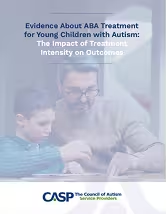
Evidence About ABA Treatment for Young Children with Autism: The Impact of Treatment Intensity on Outcomes
ABA therapy helps young children with autism learn important life skills like talking, playing, following directions, and becoming more independent. Research shows that starting therapy early can help children make bigger gains in communication, learning, social skills, and everyday activities. The goal of ABA is to help children learn across many areas so they can participate more fully at home, at school, and in the community.
The report explains that children who receive more hours of ABA therapy each week often make greater progress than children who receive fewer hours. Children receiving high-intensity ABA therapy, about 26–40 hours each week, showed stronger improvements in thinking skills, communication, daily living skills, and reducing autism-related challenges compared to children receiving moderate or low amounts of therapy.
Researchers also found that therapy works best when it is started early and continued consistently over time, usually for two or more years. While every child grows at their own pace, studies showed that many children who received intensive ABA therapy were better prepared for school, needed fewer supports later, and continued to benefit from the skills they learned as they got older.
https://www.casproviders.org/evidence-intensive-early-aba
The report explains that children who receive more hours of ABA therapy each week often make greater progress than children who receive fewer hours. Children receiving high-intensity ABA therapy, about 26–40 hours each week, showed stronger improvements in thinking skills, communication, daily living skills, and reducing autism-related challenges compared to children receiving moderate or low amounts of therapy.
Researchers also found that therapy works best when it is started early and continued consistently over time, usually for two or more years. While every child grows at their own pace, studies showed that many children who received intensive ABA therapy were better prepared for school, needed fewer supports later, and continued to benefit from the skills they learned as they got older.
https://www.casproviders.org/evidence-intensive-early-aba